Pickleball Paddlemaxxing Gone Wrong
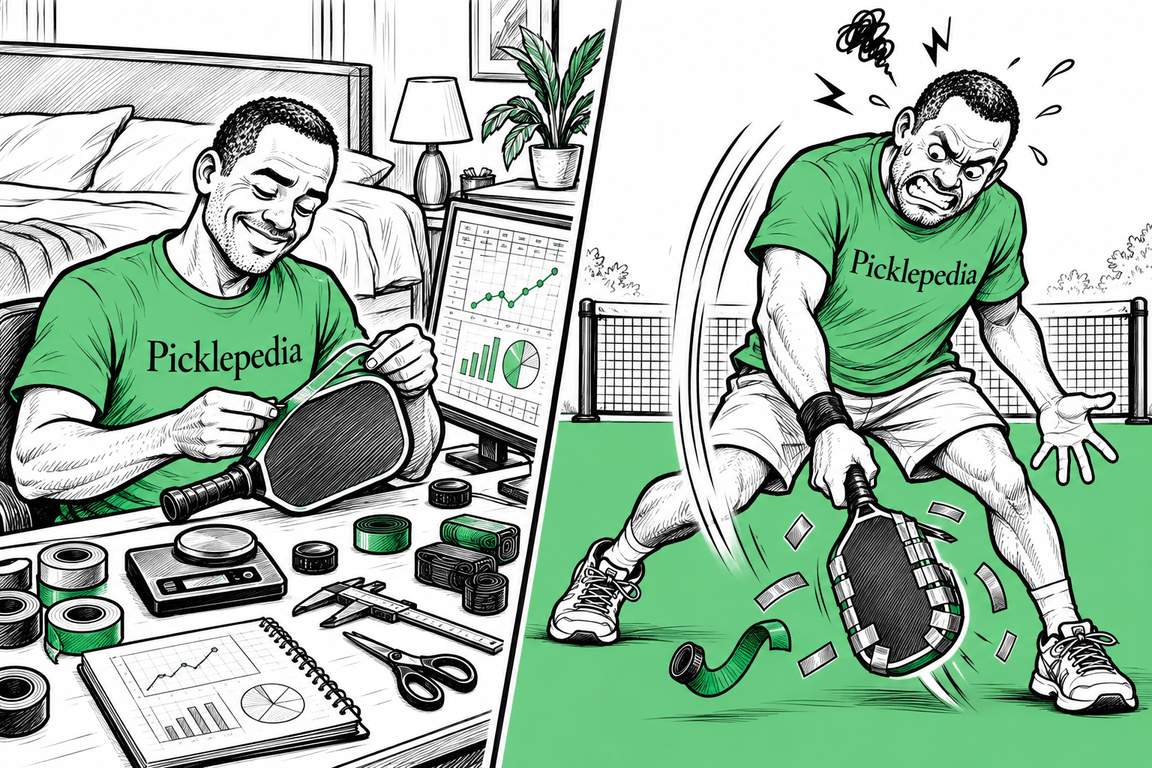
The optimizer does not begin with pickleball. Pickleball merely finds him eventually.
Every club has one. You know him.
Before the paddle there was the coffee grinder with its numbered dial, the cycling power meter that turned a pleasant Saturday ride into a quarterly earnings call, the golf launch monitor that informed him the problem was still his swing, and mechanical keyboard switches ordered from three countries because the first set was a little too scratchy.
He is not ridiculous. Optimizers often know things. Coffee does taste different. Keyboard people, against all odds, can hear things.
Then he discovers pickleball. For perhaps six weeks, he is happy.
There Was Once Just a Paddle
The first paddle is purchased with suspicious ease. He reads some reviews, selects something described as forgiving but powerful, and goes to the courts.
He hits the ball. The ball comes back. This is intoxicating. Pickleball, unlike golf, immediately provides the optimizer with the illusion that competence may be available by Thursday.
Then one day a hard volley catches slightly outside the sweet spot and the face twists in his hand. This is how it starts.
He learns the word twistweight. Soon he learns that adding tungsten around 4 and 8 o’clock can raise it. This is not snake oil. He orders the tape. The tape works.
Not financially, obviously. Nothing in this story is free. But psychologically, the first successful adjustment costs almost nothing. The paddle feels calmer.
There is precedent for the excitement. In a Reddit thread about a Paddletek Bantam ESQ-C, one player wrote that he gradually added tungsten around the entire perimeter, taking the paddle from 7.6 ounces stock to 8.7 ounces, and called the finished setup “an absolute beast.”
The optimizer sees something slightly different. He sees proof that there are hidden versions of his paddle waiting to be unlocked. The factory, apparently, stopped early. He can finish the job. A second strip goes on. Then an overgrip. Edge tape is added because the paddle should be protected. The edge tape adds weight, which means the balance has changed, which means the balance must now be considered. The paddle has become a system. And systems require management.
Tuesday Is Where the Science Gets Complicated
The optimizer starts arriving at open play with accessories: tape in the bag, tiny scissors, possibly a digital scale that has never once been used for food. Between games, he studies the paddle with the seriousness of a pit crew inspecting front-tire degradation.
Then the internet introduces professional setups. This is dangerous. Professional athletes are catnip to optimizers because they make preference look like engineering.
In a Reddit discussion about tungsten setups, one player wrote that he copied a Ben Johns-style configuration, liked the extra defense, but also noticed slower swing speed and fatigue about an hour into play. Another commenter warned that copying a setup without knowing what problem needed fixing amounted to “trial and erroring blindly.”
Then comes a second paddle, necessary because the first one has become too powerful. Or perhaps not powerful enough. The diagnosis depends somewhat on the most recent loss. For two sessions, this feels like the answer. Then Tuesday happens: the dinks sit up, a third-shot drop sails long, hands feel slow in a firefight.
Tuesday begins magnificently. In warm-ups the paddle feels like it was machined for him personally. Twenty minutes later he is late on everything. At 7–7 he loses a hands exchange because the paddle arrives roughly half a Tuesday behind his wrist. Then he pushes a routine dink long.
He looks at the paddle. Not his feet. Not the ball. The paddle.
Between games, two strips of tungsten come off. Now the paddle feels quick but unstable. He loses another firefight and puts one strip back on. After a third shot dies in the net, the paddle meets his thigh with more force than any optimized object should require. By lunchtime he has run three equipment experiments and learned absolutely nothing.
Bad games create uncertainty. Equipment offers a beautifully concrete answer. Footwork is difficult to inspect in the parking lot. A late contact point cannot arrive from Amazon tomorrow. Tungsten can. Equipment is especially seductive because it lets a player change something without admitting that the thing requiring work might be the player.
So the tape moves. The overgrip changes. A third paddle begins appearing in browser tabs. Two games later, the tape moves again. The tungsten had not been the mistake. Changing the question after every session had.
To be fair, paddle technology really is moving quickly. The optimizer is not imagining that. He is merely assuming that because equipment matters, it must explain what happened this morning.
Then He Starts Helping
You might expect a man whose system has stopped producing answers to question the system. Instead, he exports it. At a certain point, managing one paddle is no longer enough. There are other paddles at the club. Other paddles, it turns out, are also unfinished.
It begins as a favor. Someone mentions a slippery grip. The optimizer happens to have a spare overgrip in the bag. He offers to wrap it carefully, almost ceremonially, as though the recipient has just been admitted into a minor priesthood. The grip feels better. Of course it does. Next week, another player asks. Then another. He starts bringing extra rolls the way some people bring spare balls.
Once you have accepted that a free overgrip can improve a paddle, it is a short walk to tungsten and the idea that the factory grip was only a suggestion. He does not need to hard-sell any of this. He merely demonstrates that there is always one more adjustment available.
What begins as free wrapping starts to look, from a distance, like an accidental multi-level marketing scheme built entirely out of court-side goodwill.
A recruit gets hooked. Then the recruit starts wrapping someone else’s paddle. Then someone produces an affiliate discount code, spoken softly near the fence as if it were a password. The proudest moment is not a ladder win. It is the announcement, usually made with the earnestness of a promotion, that they have become an official partner.
No one planned a downline. It simply happened that the person who knew how to change a grip also knew where to buy the next upgrade.
Meanwhile, one court over, someone is playing with a paddle that has not changed in eight months. The grip is worn. And the player knows exactly what happens when the ball catches the paddle half an inch too low.
The Final Upgrade Is Usually Boring
Saturday is the club ladder final. Across the net stands the player with the eight-month-old paddle, partnered, of all people, with a recruit whose grip the optimizer wrapped himself. The optimizer has re-taped the night before. On the deciding point his drop floats, the worn paddle punches it away, and the recruit politely says nothing.
Walking off, the optimizer blames the tape.
This is the part the optimizer resists.
The player with the unchanged paddle has accumulated something difficult to buy: a stable relationship between action and result. A dink floats high. The paddle was the same yesterday, so the list of suspects gets shorter.
Customization is not the enemy. The better rule is almost painfully dull: Name one problem. Change one thing. Leave it alone, long enough to find out what happened. Do not simultaneously change the grip, buy another paddle and judge the experiment by whether Tuesday’s ladder match was won.
Eventually, the optimizer reaches a point where there is nothing left to tune without admitting something unpleasant. The paddle is fine. The third shot is still going into the net. The paddle simply returns the same information again: contact was late, feet were still moving, the shot selection was hopeful.
This is the optimizer’s least favorite kind of data because it cannot be purchased, installed or delivered by Thursday.
Every club has one. You know him.
Eventually, if he is lucky, he runs out of paddle to fix.