How to Synchronize Footwork With Your Pickleball Partner (Lessons From the Sports That Live in Sync)
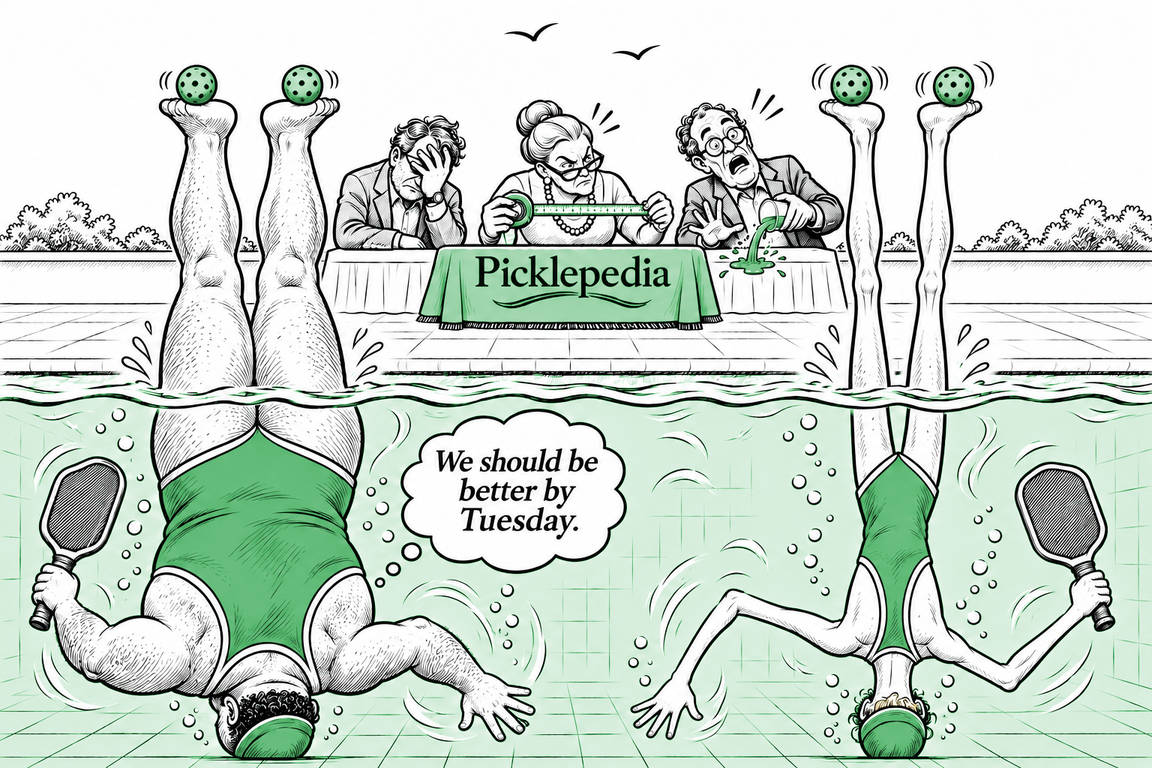
Two swimmers hang upside down in a pool, holding their breath, while music reaches them through underwater speakers and every movement sits on a count of eight. Brazil’s Luisa Borges, after seven years training with Duda Micucci, told CCTV: “I may sense that she will pause a little. I see her out of the corner of my eye, and I will, almost instinctively, pause too.” American Anita Alvarez told the Press-Enterprise: “We even have to smile and lift our brows at the same time in the same way.” She and Mariya Koroleva reviewed the day’s videos in their dorm to become mirror images.
Synchronized swimming, now called artistic swimming, is the sport people picture first when they hear “in sync.” Ottoline and Bram, an imaginary pair at a typical club, are not. They have played together for three years. Yet when Ottoline slid left to cover a crosscourt dink, Bram tended to stay put, admiring his last shot, and the gap was wide enough that one opponent called it “the express lane.”
Beach volleyball teams, tennis doubles pairs, rowing crews and figure skaters also train to move as one. Fortunately, learning their methods does not require a nose clip or sequins.
Artistic Swimming: Count It on Dry Land, Then Film It
At Suncoast WaterWorks in Largo, Florida, swimmers mark their counts on deck before they get in, sometimes arguing over them. Later, in the water, assistant coach Shea Tombrink ran one element in slow motion to steady clapping, filmed it and played it back. Kristin Walton told Yahoo Sports that teammates rely on “beeping,” a short audible signal.
At the kitchen line, with no ball, have someone across the net point to the left sideline, the right sideline or the center. Both shift toward that side, but not the same distance. The player on that side covers the line, and the partner slides far enough to protect the middle. On “center,” both return to their starting spots. Repeat ten times to a steady count, then swap who points. The first time, Bram treated “center” as an invitation to meet Ottoline in the middle.
Film ten seconds of the pair shifting, watch at half speed, and pause at the first moment one partner moves while the other stays planted. Rehearse that movement five times and film again.
Beach Volleyball: Agree Before the Serve
Kerri Walsh Jennings, usually the blocker, would signal behind her back before the serve which side she was blocking, and Misty May-Treanor covered the rest. If the play changed, she told SI Kids, “I’ll say switch,” meaning a change in who covers which area, not a change of sides. Her rule: “I need my partner to trust what I just called, at all times.”
Before playing, agree on three things: who takes the middle, how you’ll handle lobs, and who closes the gap when one partner is pulled wide. For two right-handers, the forehand often takes the middle.
On a pickleball court, “Mine” means I am taking the ball, and “Switch” means the pair is swapping sides after one partner crosses. On a lob, the player with the best angle and safest path goes, calling “Mine” early, and “Switch” if they are crossing, while the partner covers the open space. Bram used to chase lobs heels first, arms out, like a man fleeing a wasp. Turn sideways, drop step and run; it is generally safer and faster than backpedaling. Rebuild the advance if the next ball allows it.
When an opponent dinks wide to Ottoline, she slides out to the line and Bram slides with her toward the middle. A sharp angle to the far sideline is often harder and riskier to hit well, so it is the space a pair can concede while protecting the middle. A ball aimed into the gap meets Bram’s paddle. The express lane is closed for repairs.
Tennis Doubles: A Sentence Before, a Sentence After
Ottoline and Bram used to play whole games in silence. Coach Paul Annacone said, “The Bryans talk before and after every point to set up plays.” Before the next point, try one sentence: “If the return floats through the middle, I’m going to poach.” After the point, another: “I should have moved across when you got pulled wide.” No committee meeting. Just enough to stop repeating the same mistake.
Mike Bryan told The New Yorker, “It’s like there is a belt tied around both your waists, five feet apart.” Bob’s reply: “More like six.” The same profile noted they rarely huddled, a luxury of decades together. Give the belt some slack, but not an easy shot through the middle.
Rowing: Match the Catch
In a rowing crew, the stroke sets the rate and the others match the catch. Three-time Olympian Will Crothers told Olympic.ca, “It’s really a special feeling of swinging together, when you get it right.” A 2017 case study of a newly formed coxless pair found tighter catch timing after six weeks and almost 50 hours together.
Bram used to sprint to the kitchen on his own clock, until Ottoline offered him a coffee each time he waited for her. He is now the most caffeinated man at the club, and they win more.
In pickleball, the timing matters more than matching every step. After a good third-shot drop, both players advance while the ball travels, then split-step just before the opponent strikes. What matters is that both are balanced and ready when the next shot comes.
Advance and Freeze is how you check the rhythm. A feeder hits drops and drives as the pair moves in from the baseline. After the ball is dead, the feeder calls “Freeze,” and both hold. Is the middle covered? Is one partner stranded so far ahead that the next ball goes at the feet? Adjust, then go again.
Figure Skating: Take Different Paths, Finish Together
Pairs coach Kerry Leitch said, “It’s the awareness of where they are, whether you are on the same step at the same time, whether the extension is the same.” Ice dancers face a more specific geometry: the partner on the inside of a turn travels a shorter arc than the partner outside, and identical steps will not keep them together. Lorna Dyer explained that the skater on the smaller arc tracks the other by aiming into their tracing, so the pair stays together through the turn.
When Ottoline is pulled wide, Bram does not need to travel the same distance or copy her footwork. He needs to move far enough to close the middle while leaving her room to recover. Try it without a ball. The ball-side player takes three bigger steps toward a sideline, while the partner takes shorter steps to close the middle, and both finish at the same moment. Reverse the direction.
The five sports leave a short list: rehearse and film, agree before the point, talk after it, time the advance, and finish together even when the steps differ. Pick the one your partnership is worst at, and spend five minutes practicing it before your next game.
Ottoline and Bram still miss a slide now and then, but their opponents have had to find a new name for the middle of the court, and nobody has come up with one yet.