Pickleball Transition Zone: How to Cross No Man’s Land Without Getting Attacked
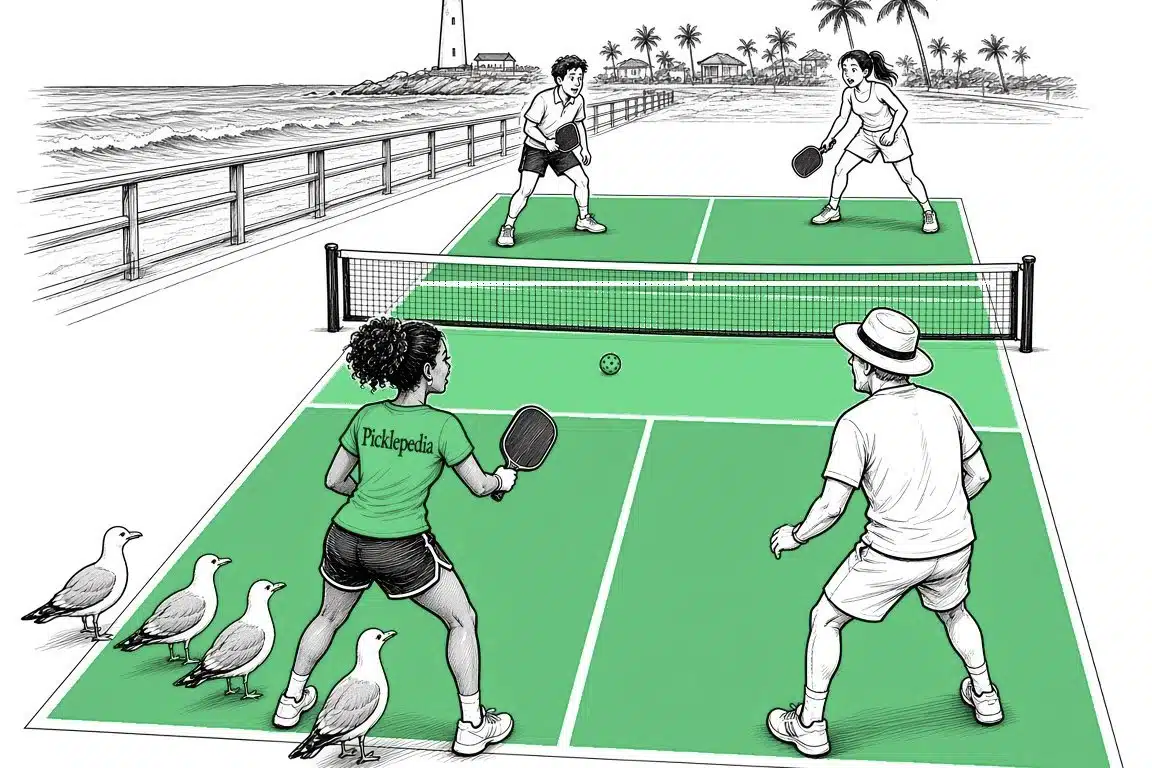
The short answer: the pickleball transition zone is the midcourt space between the baseline and the kitchen line, and you cross it in stages. Move forward behind a good shot, stop with a split step as your opponent swings, reset any low ball into the kitchen, and repeat until you reach the line.
Most players get attacked there for one reason: they treat it like a hallway instead of a staircase. They sprint, get caught mid-stride, and watch a ball zip past their feet. Here is how to climb it one step at a time.
What Is the Pickleball Transition Zone?
Each half of a pickleball court is 22 feet deep. The first 7 feet from the net is the kitchen, or non-volley zone, which leaves about 15 feet between the kitchen line and the baseline. Players call most of that space the transition zone, midcourt, or no man’s land.
It is a tactical term, not a rule. There is no line marking it, and you can stand there as long as you like. You just usually don’t want to.
Why You Get Attacked in the Pickleball Transition Zone
From the kitchen line, a player can often meet the ball near or above the top of the net, which is 36 inches high at the sidelines and 34 inches at the center. From midcourt, the same ball has usually dropped below net height by the time it reaches you, so you have to hit up. Anything you lift too much becomes an attackable ball.
Your opponents know this. Their favorite target is your feet, because a ball at your shoelaces is hard to hit down and hard to hit hard. Add the fact that you are often still moving when they swing, and the zone becomes the place where rallies end.
No man’s land isn’t dangerous because of where you stand. It is dangerous because of what you are doing when the ball arrives.
How to Cross the Pickleball Transition Zone: Move, Stop, Read
Think of the crossing as two or three short stages rather than one run. Receivers usually have it easier, because a deep return gives them time to walk in behind it; the serving team does most of the climbing. Each stage has the same rhythm.
- Move forward while your shot is traveling and your opponent can’t yet hurt you.
- Stop with a split step just as your opponent makes contact: feet shoulder-width apart, knees bent, paddle out in front around chest height.
- Read the ball, play it, and decide whether you have earned the next stage.
How far you move depends on how good your last shot was. Use this as a rule of thumb.
| Your last shot | What it looks like | What to do |
|---|---|---|
| Green light | Low, lands in their kitchen, opponent has to hit up | Move forward several steps, split step, keep coming |
| Yellow light | Medium height, lands around their kitchen line | Take a step or two, split step early, expect a firm ball |
| Red light | High or short, opponent can attack it | Stop where you are, get low, defend; don’t run into it |
The red light is the rule most players break. Running forward behind a high ball only shortens your reaction time. A good shot buys you steps. A bad shot buys you nothing, so stand still and defend. Solid footwork patterns make those stops balanced instead of lurching.
The Best Shots for the Pickleball Transition Zone
Your goal in midcourt is not to win the point. It is to hit a ball your opponents can’t attack, so you can take the next stage.
The reset. A soft, short-swing block that lands the ball in the opponents’ kitchen. It turns their attack into a neutral dink rally. Keep your wrist firm, absorb the pace with a loose grip, and push gently through the ball. Picklepedia’s guide on how to reset in pickleball has drills for it.
The drop. The third-shot drop is how most serving teams start the crossing. If the opponents handle pace poorly, a drive can work instead, but it often needs a fifth-shot drop to finish the approach. The drop-or-drive decision is worth learning.
The half volley. When a ball lands at your feet, take it just after the bounce with a short lifting motion rather than a swing. Because it has bounced, it is not a volley, so it’s legal anywhere on the court.
The block volley. If a hard ball comes at your body before it bounces, hold the paddle out front and let it rebound softly. A big swing here usually sends the ball into the net or pops it up for an easy putaway.
Crossing the Transition Zone With Your Partner
In doubles, partners should move as if connected by a short rope, roughly side by side. If one charges while the other hangs back, the gap between them is exactly where a smart opponent aims. Middle balls should be claimed early with a clear “mine” or “yours.”
The player who hit the weaker shot sets the pace. If your partner’s drop floats, both of you stop, even if your side of the court feels safe. If a lob goes over one of you while you’re advancing, the partner on the other side usually chases it and calls “switch.”
A Worked Example: Crossing No Man’s Land in One Point
Here is an illustrative doubles point. Mara and Theo are serving; Priya and Dev are receiving and already at the kitchen line.
| Shot | What happens | Transition zone decision |
|---|---|---|
| 3 | Mara’s third-shot drop lands in Dev’s kitchen | Green light: Mara and Theo move up together |
| 4 | Dev dinks at Theo’s feet in midcourt | Both split step as Dev makes contact |
| 5 | Theo half-volleys a soft reset into the kitchen | Low enough to keep moving; they take a few more steps |
| 6 | Priya drives a firm ball at Mara’s hip | Mara blocks it short instead of swinging |
| 7 onward | Mara and Theo arrive at the line together | The dink rally starts on even terms |
Nobody hit a winner. They crossed 15 feet by making three unattackable shots in a row, which is how most transitions succeed.
Pickleball Transition Zone Drills
Reset-and-step. One player stands at the kitchen line and feeds firm balls at a partner’s feet in midcourt. The partner resets each into the kitchen, takes one step forward only if the reset was low, and repeats until they reach the line. Restart from the baseline after any pop-up.
Freeze on contact. Walk forward from the baseline while a partner at the kitchen line counts down and hits. You must be in a split step, paddle out front, at the moment of contact. It builds the timing that keeps you from getting caught mid-stride.
Common Pickleball Transition Zone Mistakes
- Running through a bad shot. A high drop is a red light. Stop and defend.
- Swinging hard at low balls. A ball below the net has to go up, which hands your opponents an attack. Use a compact volley or a block instead.
- Backpedaling. Retreating while the ball is coming at you is slow and unbalanced. Hold your ground and block.
- Standing upright. A tall stance makes feet balls harder. Stay low with your paddle out front.
- Leaving your partner behind. Move together, or the middle opens.
Treat the transition zone as a staircase, not a hallway: one good shot, one stage, one split step at a time.
FAQ: Pickleball Transition Zone
Is it against the rules to stand in the transition zone?
No. It’s a tactical term, not a rule. You can play from anywhere on your side of the court; midcourt is simply a harder place to defend from.
How long should I stay in the transition zone?
As briefly as your shots allow. Two or three stages is typical, but if your shots are high, staying put and defending beats rushing.
Should I ever stop in no man’s land?
Yes, every time your opponent hits. A split step at contact matters more than how far forward you are.
What shot should I hit from the transition zone?
Usually a reset or drop into the opponents’ kitchen. Attack only a ball you can meet comfortably above net height.
Can I hit a ball in the kitchen after it bounces?
Yes. The kitchen rule only bans volleys while you touch the zone or its line. You can step in any time to play a ball that has bounced.
How do I get better at transitioning?
Drill resets from midcourt and practice freezing at contact. For the bigger picture, see Picklepedia’s doubles strategy framework.