How to Win at Pickleball: The Doubles Strategy Framework That Holds Up Under Pressure
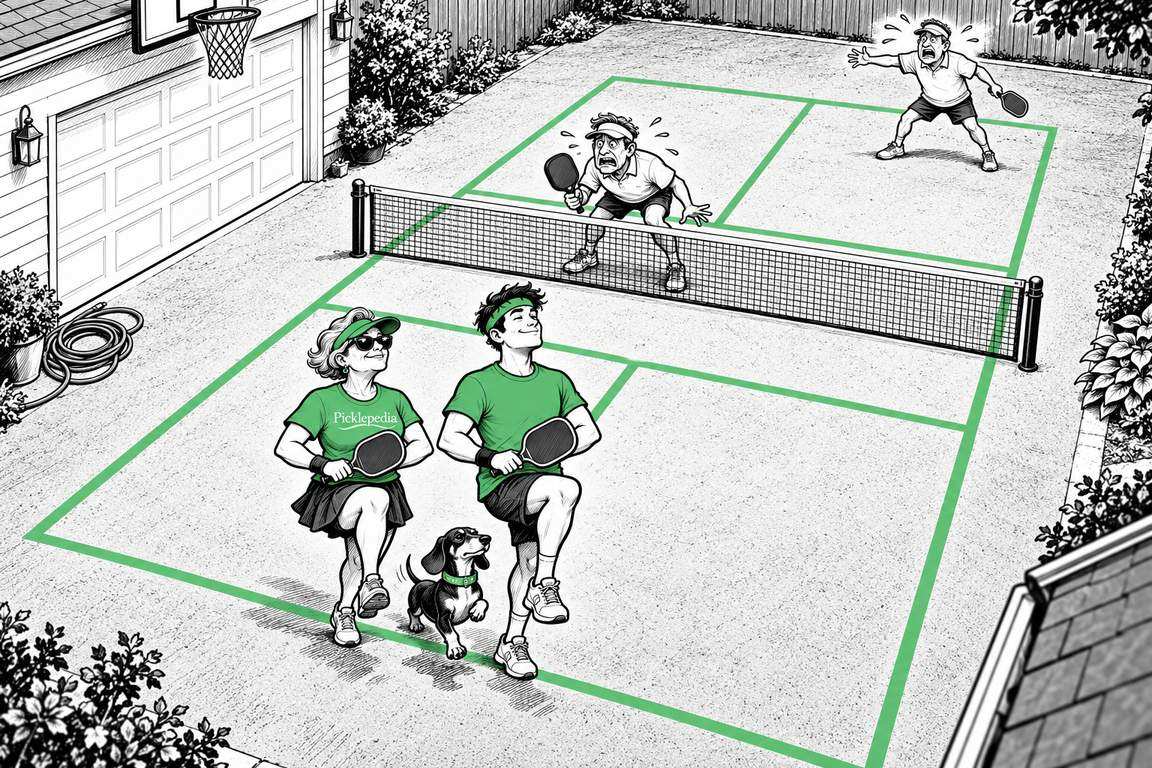
The short answer to how to win at pickleball in doubles: reach the kitchen line together, keep the ball low and aimed at the middle, and attack only balls that rise above net height. The team that owns the net and misses less beats the team that hits harder far more often than the reverse.
That advice is easy to agree with on the drive to the courts. It gets harder to follow at 9-9 with a partner who just missed two returns. What follows is a framework built for that moment, with fewer decisions and clear defaults to fall back on when your hands get tight.
How to Win at Pickleball Starts With the Two-Bounce Rule
Under the two-bounce rule, the serve must bounce before the receiver plays it, and the return must bounce before the serving team plays it. Only then can anyone volley. The receiver can walk toward the net behind the return, while the serving team waits at the baseline for it to bounce, so the receivers often reach the net first.
Doubles strategy is mostly the serving team trying to erase that head start and the receiving team trying to protect it.
The prize is the edge of the non-volley zone, or kitchen, which extends 7 feet from the net on each side. You can’t volley while touching the kitchen or its line, and it’s a fault if momentum carries you in after a volley. You can step in any time to play a ball that has bounced.
The Four-Part Doubles Framework for Winning at Pickleball
Four principles carry the load. Each is short enough to remember when your heart rate is up, and they work in order.
| Principle | What it means | Default shot | How it breaks down |
|---|---|---|---|
| Line | Both partners reach the kitchen line, side by side | Deep return, third-shot drop | One partner charges while the other stays back, opening the middle |
| Low | Force opponents to hit up | Drop, dink, soft block | Lifting the ball with a wristy dink |
| Middle | Aim between opponents or at their feet | Middle drive, middle dink | Hunting sidelines with no real opening |
| Wait | Attack only balls above net height | Patient dinks until one floats | Speeding up a ball below the net |
The middle deserves a note. The net is 36 inches high at the sidelines and 34 inches at the center, so a middle ball has more clearance, and a shot between two opponents forces a split-second decision about who takes it. When you don’t see an obvious opening, the middle is usually the safest default.
How to Win at Pickleball Points From the Transition Zone
The serving team’s job on the third shot is to get forward without getting punished. The classic tool is the third-shot drop, a soft ball that lands in the opponents’ kitchen. Because it lands low, the receivers have to hit upward, which gives the serving team time to move in.
A good third shot doesn’t need to win the point. It needs to buy you three steps.
A third-shot drive works against opponents who handle pace poorly, though it often needs a fifth-shot drop to finish the approach. Either way, move up in stages. Take a few steps, then split step as your opponent strikes the ball. If the next ball arrives at your feet in midcourt, block it softly back into the kitchen, a reset, and keep advancing.
Receivers should hit the return deep, down the middle or to a backhand, with enough height to buy time to reach the line.
Winning Doubles Pickleball at the Kitchen Line: Patience With a Trigger
Once all four players reach the line, the dink exchange begins. Crosscourt dinks give you the most margin, because the ball travels a longer diagonal over the lower center of the net.
Patience works better when you know exactly what you’re waiting for. A ball you can meet above net height while balanced is usually your green light to speed up, and a strong target is the opponent’s hip or shoulder on their paddle side.
Patience without a trigger is just waiting. Patience with a trigger is a plan.
Partners should shift together and talk early. Use short, consistent calls: “mine” or “yours” on middle balls, “bounce” when a ball looks like it’s going long, and “out” when you’re sure it is. Agree beforehand who owns different middle balls; forehand priority is a useful starting point, but positioning and the ball’s direction matter too. If a lob goes over your partner, the crosscourt player usually chases it while calling “switch,” and the lobbed player slides across to cover the open side.
A Worked Example: One Point, Shot by Shot
Here is an illustrative rec doubles point in side-out scoring. The score is called 9-8-2, meaning the serving team has 9, the receivers have 8, and the second server is up. Ines and Roland are serving; Pauline and Desmond are receiving.
| Shot | Player | What happens | Why it works |
|---|---|---|---|
| 1 | Roland | Serves deep to Desmond’s backhand | Keeps the receiver back |
| 2 | Desmond | Returns deep down the middle; both receivers move to the line | The receivers protect their head start |
| 3 | Ines | Third-shot drop into Pauline’s kitchen | Pauline must hit up; Ines and Roland advance and split step |
| 4 | Pauline | Dinks at Roland’s feet in midcourt | She targets the player still moving |
| 5 | Roland | Soft reset into the kitchen, then steps to the line | All four players are now at the net |
| 6 to 9 | Ines and Desmond | Trade crosscourt dinks | Nobody has a ball above the net yet |
| 10 | Desmond | His dink floats a few inches above the net | The trigger appears |
| 11 | Ines | Speeds it up at Pauline’s paddle-side hip | Forces a defensive block |
| 12 | Roland | Calls “mine” and puts away Pauline’s pop-up in the middle | Pre-agreed middle coverage means no hesitation |
The score moves to 10-8. Nobody sped up a low ball, and Roland, under pressure at his feet, reset instead of swinging. The point went to the team that made the right ordinary shot eleven times in a row.
How Scoring Format Changes the Way You Win at Pickleball
In traditional side-out scoring, only the serving team can score. Games usually go to 11, win by 2, and both partners serve before the serve passes over, except at the start of the game, when only one player on the first serving team serves. A lost rally on return hands your opponents a point.
In rally scoring, every rally produces a point, and under the 2026 USA Pickleball rulebook the receiving team can also win game point. Side-out remains the default for sanctioned play. Under either format, reliable serves and returns pay off.
How to Win at Pickleball Under Pressure: Mistakes That Lose Close Games
Under stress, swings get shorter and stiffer, and the same handful of errors show up again and again.
Rushing in behind a weak shot is the first. If your drop floats high, stop and get balanced in midcourt rather than running into a volley at your feet. Speeding up a low ball is the second, since a ball struck below the net has to go up, and a well-positioned opponent will send it back down. Silence on middle balls is the third, and it is usually fixed with one early call. The fourth is leaving the lob undefended, which a rehearsed “switch” handles.
A pressure plan should make your margins bigger, not your shots braver. Aim dinks a little higher over the net and farther from the sidelines, serve and return deep to the middle, and agree on one thing between points, then play.
At 9-9, the team that simplifies usually beats the team that tries something new.
FAQ: How to Win at Pickleball in Doubles
What is the single most important doubles strategy?
Getting both partners to the kitchen line together. Controlling the net forces opponents to hit upward, which creates the attackable balls that end points.
Should I hit a third-shot drop or a drive?
Both have a place. The drop is the more reliable way to get forward. A drive works against opponents who struggle with pace, but plan to follow it with a drop or reset.
Where should I aim if I’m not sure?
The middle is usually the safest default. The net is lowest there, and the shot forces your opponents to decide who takes it.
Can I stand in the kitchen?
Yes, any time you aren’t volleying. You can’t volley while touching the kitchen or its line, and it’s a fault if momentum carries you in after a volley.
Does rally scoring change how I should play?
It raises the cost of errors, since every rally produces a point. Serves and returns should prioritize staying in play.
How do I stop losing close games?
Widen your margins as the score tightens. Hit higher over the net, stay away from the lines, aim at the middle, and call every middle ball early.