When to Disrespect the X in Pickleball: The Only Times Your Forehand Should Steal the Middle
Answering a question from our community
One of our community members, a 3.5 player in France, has been losing a quiet argument with geometry. It starts whenever a ball drops between him and his partner. He was taught forehand priority, where the forehand in the middle takes the middle ball, so he goes for it. Sometimes that ball is drifting away from him, roughly 90% of the way into his partner’s territory, and he arrives late and sideways with his paddle face pointing somewhere near the next court.
He made two sharp observations. The “middle” moves, opening well away from the centerline on crosscourt and angled balls. And a ball coming toward you is easier to play than a ball traveling away from you. The videos he found showed only a ball straight down the centerline with four players standing still, which helps about as much as a weather forecast that says “weather.”
Neither forehand priority nor Respect the X appears in the rulebook. Both are coaching defaults that partners agree to use.
What the X Actually Is
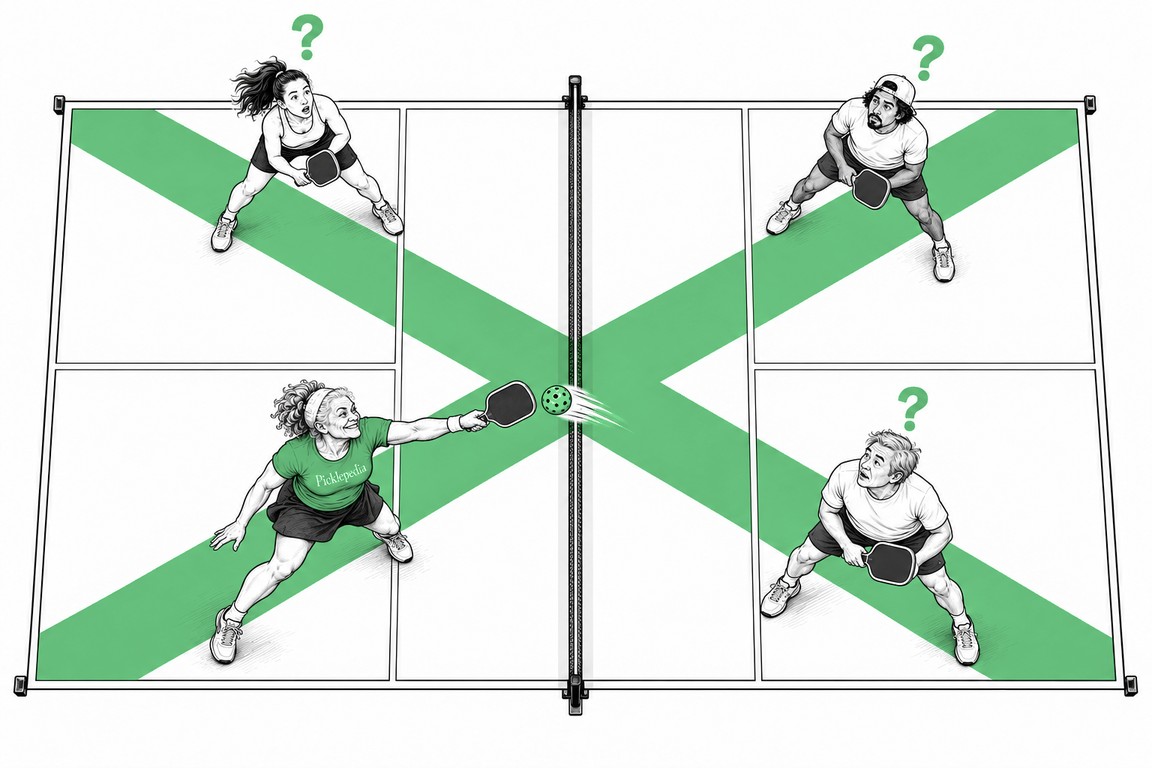
Draw a line from each player at the kitchen to the opponent diagonally across the net and you get an X, a picture of the diagonal ball paths between opposing players. Tony Roig of Better Pickleball says he developed his Respect the X framework in 2018. When a ball comes through the middle, the player diagonal from the hitter usually takes it, forehand or backhand.
In Scenario 1, you’re on the left and your partner is on the right, both right-handed. The opponent straight across from you hits into the middle. That ball angles toward your partner, who is diagonal from the hitter, so it’s their ball even on their backhand. Your forehand stays home and guards your line.
Why the Incoming Ball Wins (and Why the Gap Moves)
The player the ball is angling toward will often have the cleaner contact out in front. A ball traveling away from you often gets chased sideways and caught late. Lunging across for it can expose your down-the-line lane and makes your partner freeze or abandon a swing. Do it often enough and you’ve taught your partner to hesitate, one of the most expensive habits in doubles.
Now the part the videos skipped. Teams shift together toward the ball, and the gap shifts with them. Follow the ball’s line, wherever the paint happens to be. In Scenario 2, a crosscourt dink pulls you wide on the right, your partner slides with you, and the gap now sits about 4 feet right of the centerline. When that same opponent speeds up into it, the ball is usually yours, since you’re diagonal and it’s traveling toward you. Your partner stays home on their line. You’re also a lefty here, so both forehands face the middle, and the X breaks a tie forehand priority can’t. Pairs with both backhands in the middle often stack instead.
Forehand Priority vs the X
Think of Respect the X as a refinement of forehand priority. Forehand priority asks who has the better stroke, and the X asks who has the better contact. Forehand preference is a tiebreaker, not permission to reach across a better-placed partner.
The quick test is whether your feet will get there before the ball does. Then check balance, contact out in front, and the space you’d leave open. If the forehand passes all three, which often happens on slower balls and rarely on a kitchen speed-up, take it.
For the medium-pace ball our reader was really asking about, the player the ball is moving toward usually takes it. On a true 50/50 ball, the player with the better contact calls it early, and that clear call settles it. An early “mine” beats two polite players watching the ball go by.
When to Disrespect the X
Your forehand has a decent case for stealing the middle on a high ball that gives you time to set up, when your partner is still moving up and you’re already set, on a planned poach you’ve signaled, or when a stronger partner takes more of the middle by agreement. Overdo that last one and sharp opponents will play behind them, as we explored in reading your opponents’ partnership.
These are the only times, and even then, call it. Disrespecting the X works when your partner knows it’s coming. When it’s a surprise, it’s a collision.
Settle it in ten seconds before the match. Fast through the middle, the X usually takes it; slow or high, the forehand can have it. Seattle coach Emily Wong likewise recommends respecting the X and agreeing beforehand on middle-ball and lob coverage in her tips for moving from 3.0 to 3.5. Here’s the fridge-door version.
| Situation | Who usually takes it | Why |
|---|---|---|
| Fast, ambiguous middle ball | The diagonal player, unless the partner has clearly better contact or coverage | Ball comes toward them; partner keeps the line |
| Medium-pace 50/50 ball | Player the ball is moving toward; better contact calls it early | Clean contact, no hesitation |
| Angled ball into a shifted gap | Player the ball is traveling toward | The gap moved with the team |
| High ball in the middle | Whoever can attack it cleanly, often the forehand | Time to set up |
| Lefty-righty, both forehands in the middle | The diagonal player | The X breaks the tie |
The 90% Ball
Back to the ball that started all this, drifting away from our community member and 90% of the way into his partner’s half. Under the X, it was never really his. His partner had it coming straight at them the whole time.
Keep your forehand. Just let it take the balls it has time for. On fast or sharply angled balls into the middle heading toward your partner, trust the player at the other end of the X.
Merci for the question.